Adams Media In Stock
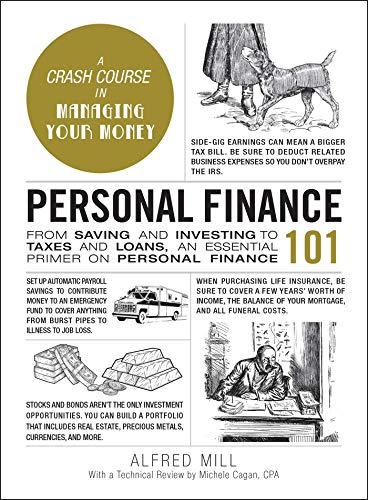
Personal Finance 101: From Saving and Investing to Taxes and Loans, an Essential Primer on Personal Finance (Adams 101 Series)
$11.25 $16.99
−34%
View on Amazon
Free CD calculator that shows your maturity value, interest earned, and APY for any certificate of deposit. Compare CD terms, compounding frequencies, and rates to find the best return on your deposit.
Using Deposit Amount: $10,000, Annual Interest Rate: 5%, CD Term: 12 months (1 year), Compounding: Monthly:
The estimated Maturity Value is $10,512 (Value at end of 12-month term).
| Result | Value |
|---|---|
| Maturity Value | $10,512 |
| Interest Earned | $512 |
| APY | 5.1% |
Adjust the values in the calculator above for your own scenario.
Preparing CD Calculator...
Every calculator is built using industry-standard formulas, validated against authoritative sources, and reviewed for accuracy against our published methodology. All calculations run privately in your browser - no data is stored or shared.
Educational tool only -- not financial, tax, or legal advice. Consult a licensed professional for decisions about your situation.
A Certificate of Deposit (CD) is a time deposit that pays a fixed interest rate for a set term -- typically 3 months to 5 years. Unlike a savings account, the rate is locked in for the full term, which protects you if interest rates fall after you open the account. CDs are FDIC-insured up to $250,000 per depositor per institution, making them one of the lowest-risk savings vehicles available. This calculator shows your exact maturity value, total interest earned, and the true Annual Percentage Yield (APY) after accounting for compounding -- so you can compare different banks and terms on an apples-to-apples basis.
CDs use compound interest applied at a set frequency throughout the term:
Maturity Value = Deposit x (1 + r/n)^(n x t)
Where r is the annual interest rate, n is the number of compounding periods per year (365 for daily, 12 for monthly, 4 for quarterly, 1 for annually), and t is the term in years.
The APY strips out the effect of compounding frequency to show the true annual return:
APY = (1 + r/n)^n - 1
A CD advertised at 5.00% compounded daily has an APY of 5.13%. A CD at 5.00% compounded monthly has an APY of 5.12%. Always use APY to compare rates across banks -- it is the only fair comparison.
Scenario 1 -- Short-term, $10,000 at 5.00% for 12 months (daily compounding): The maturity value is $10,513. Interest earned: $513. APY: 5.13%. This is suitable if you expect rates to rise and want to reinvest in 12 months.
Scenario 2 -- Mid-term, $25,000 at 4.75% for 24 months (monthly compounding): The maturity value is $27,456. Interest earned: $2,456. APY: 4.84%. Locking in nearly 5% for 2 years makes sense if you believe rates will decline before the term ends.
Scenario 3 -- CD ladder, $50,000 split across five $10,000 CDs: Allocate $10,000 each to 12, 24, 36, 48, and 60-month CDs at rates of 5.00%, 4.80%, 4.60%, 4.50%, and 4.40%. Total interest earned across all five CDs over the 60-month period: approximately $13,800. As each CD matures, you reinvest in a new 60-month CD, eventually having one $10,000 CD maturing every year at the long-term rate.
| Deposit | Annual Rate | Term | Compounding | Maturity Value | Interest Earned | APY |
|---|---|---|---|---|---|---|
| $5,000 | 4.75% | 6 mo | Daily | $5,119 | $119 | 4.86% |
| $10,000 | 5.00% | 12 mo | Daily | $10,513 | $513 | 5.13% |
| $10,000 | 5.00% | 12 mo | Monthly | $10,512 | $512 | 5.12% |
| $10,000 | 5.00% | 24 mo | Monthly | $11,049 | $1,049 | 5.12% |
| $25,000 | 4.75% | 24 mo | Daily | $27,456 | $2,456 | 4.86% |
| $25,000 | 4.50% | 36 mo | Monthly | $28,535 | $3,535 | 4.59% |
| $50,000 | 4.40% | 48 mo | Monthly | $59,716 | $9,716 | 4.49% |
| $50,000 | 4.25% | 60 mo | Daily | $61,784 | $11,784 | 4.34% |
| $100,000 | 5.00% | 12 mo | Daily | $105,127 | $5,127 | 5.13% |
| $100,000 | 4.50% | 60 mo | Daily | $123,568 | $23,568 | 4.60% |
Comparing stated rates instead of APY. Bank A advertises 5.00% with monthly compounding (APY 5.12%) and Bank B advertises 4.98% with daily compounding (APY 5.11%). On a $50,000 deposit over 12 months, the difference is about $5 -- negligible. But comparing a 4.90% monthly against a 5.00% quarterly saves you from choosing a lower-yielding option that looks identical on the rate sheet.
Ignoring early withdrawal penalties. On a $25,000 two-year CD at 4.75%, the bank may charge a 6-month interest penalty for early withdrawal. If you break the CD after 9 months, the 6-month penalty ($594) eats over 70% of the $844 you earned. Always check the penalty schedule before committing funds you might need.
Keeping a large cash balance at a big bank's standard CD rate. Major retail banks routinely offer 0.50%-1.00% on CDs while online banks and credit unions offer 4.50%-5.25% for the same terms. On a $50,000 CD over 12 months, the difference between 0.75% and 5.00% is $2,125 in lost interest -- for identical FDIC protection.
Over-concentrating in one long-term CD before a rate cycle turns. Locking $100,000 into a 5-year CD at 4.25% just before rates rise to 5.50% costs you over $6,000 in foregone interest over the remaining term. A ladder or a shorter initial term gives you the flexibility to reinvest at higher rates without triggering a penalty.
Compound Interest Calculator: Try our free compound interest calculator for instant results.
Savings Calculator: Try our free savings calculator for instant results.
401(k) Calculator: Try our free 401(k) calculator for instant results.
IRA Calculator: Try our free ira calculator for instant results.
Roth IRA Calculator: Try our free roth ira calculator for instant results.
Retirement Calculator: Try our free retirement calculator for instant results.
Copy this citation for papers, articles, or coursework:
Alex Crabinsky. "CD Calculator." Numeraty, February 23, 2026, https://numeraty.com/cd-calculator/ Clear, top-rated primers on saving, planning, and managing money.
As an Amazon Associate, we earn from qualifying purchases. Prices and availability are subject to change. Prices checked Sep 9, 2026.

Free 401(k) calculator that projects your retirement balance based on salary, contribution rate, employer match, and investment growth. See how increasing your contribution by just 1% can add tens of thousands to your nest egg.
Savings & InvestmentCalculate how much to save in a 529 plan for college expenses. Estimate tax-free growth, compare contribution strategies, and project future education costs with our free calculator.
Savings & InvestmentFree annuity calculator that projects the future value of regular contributions with compound interest. See how monthly, quarterly, or annual payments accumulate over time for retirement planning, education funding, or long-term savings goals.
Savings & InvestmentCalculate your annuity payout amounts with our free calculator. Estimate monthly, quarterly, or annual income from your annuity balance based on payout rate, period, and frequency.
Savings & InvestmentCalculate Annual Percentage Yield (APY) from any stated interest rate and compounding frequency. Compare APY across accounts and understand how compounding frequency affects your real earnings.
Savings & InvestmentEstimate the future cost of college including tuition inflation. Calculate how much you need to save for a 4-year degree at public, private, or out-of-state schools with our free calculator.
Savings & InvestmentFree compound interest calculator that shows how your money grows over time. Enter your principal, rate, contributions, and compounding frequency to project future value, total interest earned, and growth charts instantly.
Savings & InvestmentCalculate how dividend reinvestment (DRIP) grows your portfolio over time. See the compound effect of reinvesting dividends vs. taking cash with our free DRIP calculator.
Savings & InvestmentCalculate how dollar cost averaging builds wealth by investing fixed amounts at regular intervals. Compare DCA vs. lump sum investing and see how volatility smoothing works.
Savings & InvestmentFree education savings calculator that projects future college costs with tuition inflation, shows your savings gap, and calculates the exact monthly contribution needed. Plan for 529 accounts, tuition funds, and education goals.
Savings & InvestmentCalculate your Financial Independence, Retire Early (FIRE) number and timeline. Estimate how many years until you can retire based on savings rate, investment returns, and annual expenses.
Savings & InvestmentFree investment returns calculator that computes your total return, percentage gain, and annualized return (CAGR) for any investment. Compare stock, real estate, crypto, or bond performance over any time period.
The FDIC reports the national average savings account rate at 0.41% APY as of early 2026, while leading online high-yield savings accounts are offering 4.0-5.0% APY -- a 10x difference that amounts to $585/year in extra interest on a $13,000 balance. The difference is structural, not temporary.
8 min read savingsThe Federal Reserve's 2024 SHED survey found that 37% of Americans couldn't cover a $400 emergency from savings alone. The standard 3-to-6-month guideline is a starting point -- your actual target depends on income stability, household structure, and health factors.
8 min read